
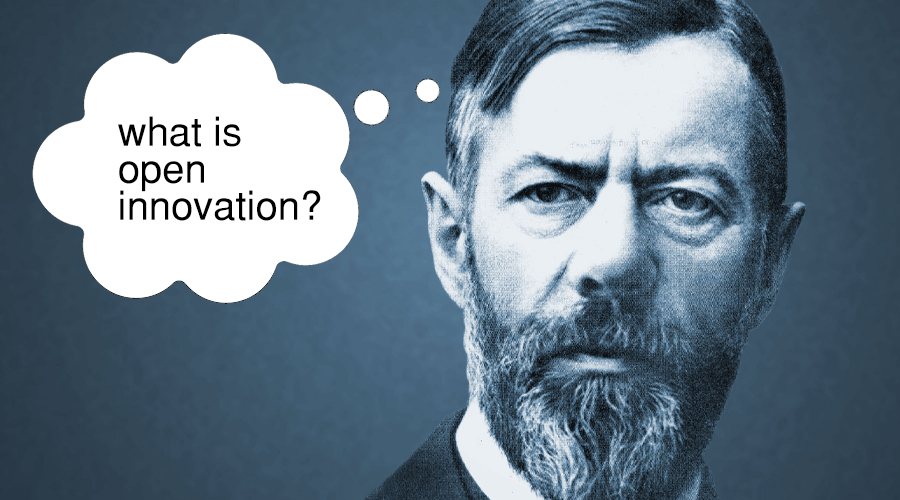
When we talk about open innovation today, we usually speak about collaboration, ecosystems, shared platforms and collective intelligence.
Max Weber described modern organizations as bureaucracies, systems built on hierarchy, rules, specialization, and rational procedures. Bureaucracy, for Weber, was not necessarily bad. It was efficient. It created predictability. It reduced chaos.
Open innovation challenges the traditional bureaucratic model. It encourages ideas to move across departments, across companies, even across industries. Instead of strict hierarchy, it promotes networks. Instead of internal control, it invites external participation. From a Weberian perspective, bureaucracy provides stability, but innovation requires flexibility.
So are they incompatible?
Not necessarily.
The most successful companies today are not those that abandon structure entirely, but those that combine structured systems with open collaboration. Think about how large corporations build innovation labs, partnerships with startups, or open-source collaborations.
Perhaps Weber would argue that open innovation only works when supported by a strong rational structure. Without some form of organization, openness turns into disorder.
The real question is not whether bureaucracy kills innovation. It is whether organizations are capable of designing structures that are stable enough to function, yet flexible enough to evolve.