What competitive advantage really means today

For decades, competitive advantage was associated with ownership: proprietary technology, patents, exclusive resources.

Today, advantage increasingly comes from connection.

Platforms dominate markets not because they own everything, but because they connect everyone. In a networked economy, sustainable advantage often lies in positioning within an ecosystem rather than controlling a single asset.

Companies like Apple, Amazon, or Microsoft do not simply sell products. They create systems where users, developers, and partners co-create value. Instead of competing firm versus firm, we increasingly see ecosystem versus ecosystem. The challenge becomes less about building a superior product and more about building a superior network. This also means competitive advantage is more dynamic.

The companies that survive are not necessarily those with the strongest product at a given moment, but those with the strongest adaptive ecosystem.

In the modern economy, advantage is no longer something you defend, but something you continuously have to change and rebuild.

Is AI the end of management?

Artificial intelligence is transforming decision-making. Algorithms analyze data faster than any human. Predictive systems can optimize logistics, pricing, and even hiring.

If AI can make better decisions, what happens to managers?

At first glance, AI seems to reduce the need for traditional management. If systems can allocate resources and forecast demand, human judgment becomes less central.

But management has never been only about calculation.

Management involves coordination, motivation, interpretation, and ethical responsibility. AI can only process information; it cannot create meaning. In innovation contexts, this distinction becomes critical. Innovation requires tolerance, vision, and deciding which risks are worth taking.

AI may enhance managerial decisions, but it does not replace the human capacity to define purpose. AI changes the tools, but leadership remains fundamentally human.

The hidden cost of metrics in innovation

Modern management loves metrics, KPIs, performance dashboards, innovation targets, quarterly reports, other management terms.

But innovation does not always behave well under measurement.

When companies start measuring the number of ideas generated, employees generate more ideas, not necessarily better ones. When innovation is tied to short-term financial returns, long-term experimentation disappears.

The hidden cost of over-measurement is that people begin optimizing for what is measured, not for what truly matters.

True innovation often begins as uncertainty. It may not generate immediate revenue, and it may even look inefficient at first. If every project must justify itself through short-term KPIs, radical innovation becomes unlikely.

This does not mean we should abandon measurement, but that we should measure learning, adaptability, and experimentation, and not just the output.

Why organizational culture matters more than strategy

Companies spend enormous amounts of time crafting strategy, and yet many fail. Not because they were wrong, but because the organization was incapable of executing them.

Strategy is a plan. Culture is behavior.

You can design the most innovative strategy on paper, but if the culture punishes risk, avoids experimentation, or resists change, the strategy will remain theoretical. Culture defines what is acceptable. It shapes how people react to uncertainty. It determines whether employees feel safe proposing new ideas.

Consider companies like Kodak. They understood digital photography. They even developed early prototypes. The problem was not lack of strategy. The problem was a culture that protected the existing business model.

In innovation-driven environments, culture often matters more than strategy because innovation cannot be forced. It emerges from behavior patterns, trust, and openness. A strong culture aligned with innovation allows imperfect strategies to evolve and improve.

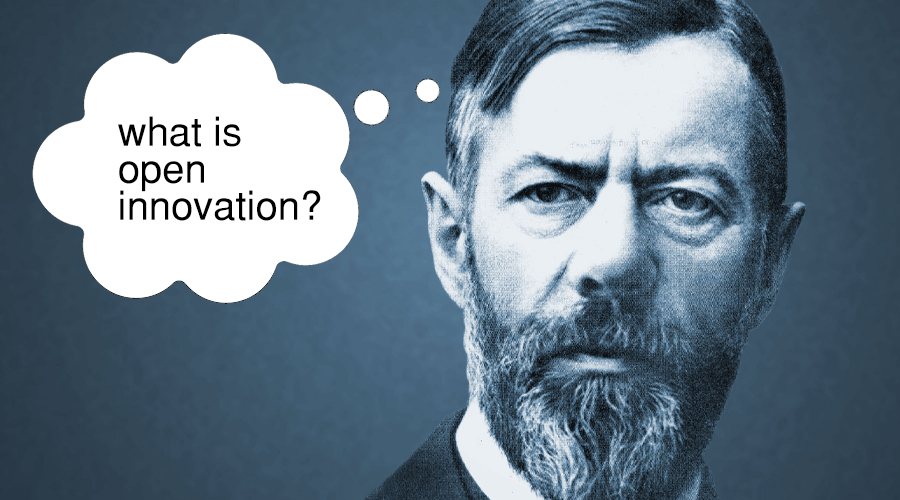
What Marx Weber would say about open innovation

When we talk about open innovation today, we usually speak about collaboration, ecosystems, shared platforms and collective intelligence.

Max Weber described modern organizations as bureaucracies, systems built on hierarchy, rules, specialization, and rational procedures. Bureaucracy, for Weber, was not necessarily bad. It was efficient. It created predictability. It reduced chaos.

Open innovation challenges the traditional bureaucratic model. It encourages ideas to move across departments, across companies, even across industries. Instead of strict hierarchy, it promotes networks. Instead of internal control, it invites external participation. From a Weberian perspective, bureaucracy provides stability, but innovation requires flexibility.

So are they incompatible?

Not necessarily.

The most successful companies today are not those that abandon structure entirely, but those that combine structured systems with open collaboration. Think about how large corporations build innovation labs, partnerships with startups, or open-source collaborations.

Perhaps Weber would argue that open innovation only works when supported by a strong rational structure. Without some form of organization, openness turns into disorder.

The real question is not whether bureaucracy kills innovation. It is whether organizations are capable of designing structures that are stable enough to function, yet flexible enough to evolve.

What Apple did right

Apple is often discussed in extremes. It is either praised as the most innovative company in the world or criticized for not being as revolutionary as it once was, but both views miss the point. Apple’s real strength was never about chasing constant novelty, but about making deliberate choices and committing to them fully.

One of the most important things Apple did right was understanding that innovation is not about features, but about experience. While competitors competed on specifications, Apple focused on how technology feels to use. Simplicity was not an aesthetic decision; it was a strategic one. By controlling both hardware and software, Apple reduced friction for users and created products that felt coherent rather than assembled.

Another thing Apple did right was aligning design, engineering, and business under a single narrative. Innovation was not isolated in a department or lab. It was embedded into how decisions were made across the organization. This alignment made execution possible, something many companies struggle with even when they have strong ideas.

Apple’s success was not the result of constant disruption, but of consistency. It didn’t try to innovate everywhere at once. Instead, it chose where to be radical and where to be stable. That balance is what many organizations miss when they try to copy Apple’s products without understanding its strategy.

In the end, Apple did not win by being the loudest innovator. It won by being intentional.

Why some companies only pretend to innovate

Every company claims to be innovative, future-oriented, and open to new ideas,  yet very little actually changes. It feels like innovation has just become the latest corporate buzzword.

Many organizations invest heavily in innovation appearance. They organize hackathons, innovation labs, internal accelerators, brainstorming sessions, all highly visible, all safe. These initiatives allow leaders to say “we are innovating” without touching core processes, incentives, or decision rights, and to them innovation becomes a performance they show off rather than a process towards improvement.

True innovation challenges comfort, existing assumptions, it questions why things are done a certain way. It exposes inefficiencies, outdated roles, and unnecessary hierarchy. That creates discomfort for the company, and that discomfort is precisely why innovation is often contained.

Examples of pretend innovation


Kodak

Kodak invented the digital camera, and then buried it. Digital photography threatened its film business, margins, and identity. Innovation existed internally, but leadership chose protection over transformation.

Lesson: Having ideas means nothing if they threaten existing revenue.

Nokia

Nokia talked about innovation constantly, but in actuality did nothing.
Internally, decision-making was slow, hierarchical, and risk-averse. Teams saw the smartphone shift coming. Leadership hesitated, debated, delayed. Innovation initiatives existed, but power stayed centralized and conservative, and didn’t give any space for the innovation to actually develop.

Lesson: Innovation dies when insight cannot travel upward.

IBM

IBM invested heavily in innovation labs, design thinking, and transformation programs, yet many of these efforts were detached from core incentives and legacy systems. Innovation was encouraged, but only if it fits in the existing business models.

Lesson: Innovation programs without structural change become corporate theater.

General Electric

GE branded itself as a digital and industrial innovator, it launched GE Digital and pushed ambitious transformation narratives. Internally, however, legacy complexity, financial pressure, and rigid management structures slowed execution. The vision was innovative, but the organization wasn’t ready to support it.

Lesson: Vision alone does not override organizational inertia.

Meta

Meta publicly promotes bold innovation, AI, VR, the metaverse. But internally, innovation is still heavily driven by growth metrics, ad revenue, and engagement KPIs. Many experiments exist, but few escape the gravitational pull of the core business, the innovation is real, but selectively allowed.

Lesson: When metrics dominate, innovation follows incentives, not imagination.

WeWork

WeWork framed itself as a tech innovator reshaping work culture, when in reality, its core model was traditional real estate with a modern narrative. They masked their weak innovation with fancy innovation language and branding.

Lesson: Branding innovation is not the same as building it.

Blockbuster

Blockbuster experimented with online rentals and partnerships. But it protected its physical-store model for too long.

Lesson: Partial innovation is as bad as none.

Habits aren’t necessarily good

Habits are praised as the foundation of success. Build good habits, repeat them daily, and results will follow. In personal development, this often works, but in organizations, it’s more complicated.

When processes become habitual, they stop being questioned. Teams do things “because that’s how it’s always been done.” What once was a smart solution becomes an unquestioned routine. Over time, habits turn into invisible rules.

Innovation requires friction, it requires stopping and asking why. Habits do the opposite, they remove friction, speed things up, and reduce cognitive effort. That’s great for stability, but terrible for evolution.

The most dangerous habits aren’t bad ones. They’re successful ones. Because success reinforces repetition, and repetition discourages change. Growth doesn’t come from perfect habits alone, it comes from knowing when to break them.

Only the paranoid survive

“Only the paranoid survive” is often celebrated as a leadership mantra. Constant vigilance, continuous scanning, relentless questioning. The idea is that leaders who assume stability are already falling behind.

Endless questioning can become indecision. Constant threat-scanning can turn into fear-based leadership. Organizations that never feel safe enough to stabilize also never feel safe enough to trust.

Grove’s famous questions push leaders to ask where change is coming from, what they might be missing, and who could disrupt them. These are useful questions, but they assume that perpetual disruption is the only meaningful state of existence.

In reality, not everything is a strategic inflection point, and not every shift is existential. Companies also need moments of consolidation, reflection, and trust in what already works.

Paranoia may help organizations survive uncertainty, but it should be a tool, not a permanent mindset. Otherwise, the goal becomes survival instead of progress.

What is a recession

The NBER’s Business Cycle Dating Committee defines a recession as “A significant decline in economic activity spread across the economy, lasting more than a few months, normally visible in production, employment, real income, and other indicators.”

That means that a recession isn’t a sudden collapse, but more of a slow tightening.

Technically, a recession is a sustained decline in economic activity, but in real life, it shows up differently. People delay purchases, companies freeze hiring, and investments become cautious.

One of the most interesting signals of recession is the lipstick effect. When people feel financially uncertain, they stop buying big luxury items, but still allow themselves small indulgences. Lipstick sells better when confidence drops. It’s not about vanity, it’s about control. Small comforts feel safer than long-term commitments.

Other indicators follow similar logic:

  • reduced consumer spending
  • layoffs in “growth” industries
  • rising interest rates
  • shrinking investments

What makes a future recession feel plausible isn’t panic, it’s pattern recognition. High debt levels, geopolitical instability, inflationary pressure, and overstretched markets don’t guarantee a recession, but they make one statistically likely.

Recessions aren’t abnormal failures of capitalism. They’re part of its rhythm. The danger isn’t the recession itself, it’s pretending it can’t happen, and being unprepared when it does.