What competitive advantage really means today

For decades, competitive advantage was associated with ownership: proprietary technology, patents, exclusive resources.

Today, advantage increasingly comes from connection.

Platforms dominate markets not because they own everything, but because they connect everyone. In a networked economy, sustainable advantage often lies in positioning within an ecosystem rather than controlling a single asset.

Companies like Apple, Amazon, or Microsoft do not simply sell products. They create systems where users, developers, and partners co-create value. Instead of competing firm versus firm, we increasingly see ecosystem versus ecosystem. The challenge becomes less about building a superior product and more about building a superior network. This also means competitive advantage is more dynamic.

The companies that survive are not necessarily those with the strongest product at a given moment, but those with the strongest adaptive ecosystem.

In the modern economy, advantage is no longer something you defend, but something you continuously have to change and rebuild.


Is AI the end of management?

Artificial intelligence is transforming decision-making. Algorithms analyze data faster than any human. Predictive systems can optimize logistics, pricing, and even hiring.

If AI can make better decisions, what happens to managers?

At first glance, AI seems to reduce the need for traditional management. If systems can allocate resources and forecast demand, human judgment becomes less central.

But management has never been only about calculation.

Management involves coordination, motivation, interpretation, and ethical responsibility. AI can only process information; it cannot create meaning. In innovation contexts, this distinction becomes critical. Innovation requires tolerance, vision, and deciding which risks are worth taking.

AI may enhance managerial decisions, but it does not replace the human capacity to define purpose. AI changes the tools, but leadership remains fundamentally human.

The hidden cost of metrics in innovation

Modern management loves metrics, KPIs, performance dashboards, innovation targets, quarterly reports, other management terms.

But innovation does not always behave well under measurement.

When companies start measuring the number of ideas generated, employees generate more ideas, not necessarily better ones. When innovation is tied to short-term financial returns, long-term experimentation disappears.

The hidden cost of over-measurement is that people begin optimizing for what is measured, not for what truly matters.

True innovation often begins as uncertainty. It may not generate immediate revenue, and it may even look inefficient at first. If every project must justify itself through short-term KPIs, radical innovation becomes unlikely.

This does not mean we should abandon measurement, but that we should measure learning, adaptability, and experimentation, and not just the output.

Why organizational culture matters more than strategy

Companies spend enormous amounts of time crafting strategy, and yet many fail. Not because they were wrong, but because the organization was incapable of executing them.

Strategy is a plan. Culture is behavior.

You can design the most innovative strategy on paper, but if the culture punishes risk, avoids experimentation, or resists change, the strategy will remain theoretical. Culture defines what is acceptable. It shapes how people react to uncertainty. It determines whether employees feel safe proposing new ideas.

Consider companies like Kodak. They understood digital photography. They even developed early prototypes. The problem was not lack of strategy. The problem was a culture that protected the existing business model.

In innovation-driven environments, culture often matters more than strategy because innovation cannot be forced. It emerges from behavior patterns, trust, and openness. A strong culture aligned with innovation allows imperfect strategies to evolve and improve.

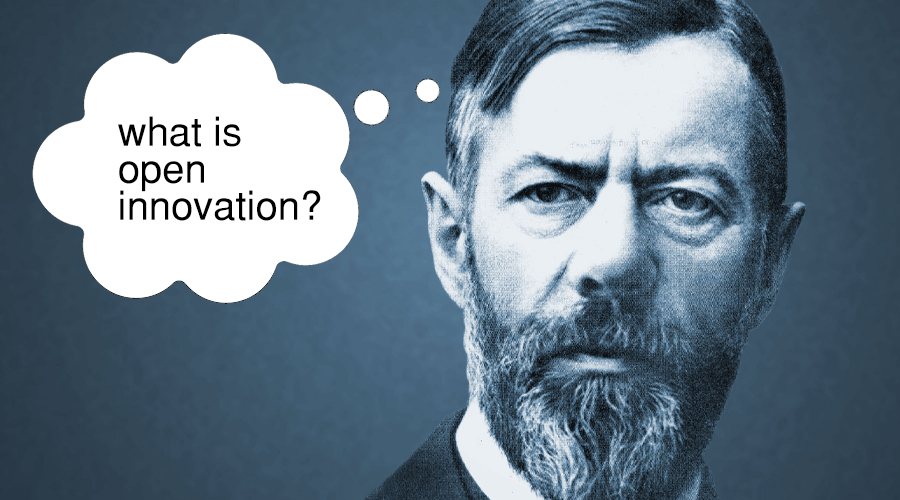
What Marx Weber would say about open innovation

When we talk about open innovation today, we usually speak about collaboration, ecosystems, shared platforms and collective intelligence.

Max Weber described modern organizations as bureaucracies, systems built on hierarchy, rules, specialization, and rational procedures. Bureaucracy, for Weber, was not necessarily bad. It was efficient. It created predictability. It reduced chaos.

Open innovation challenges the traditional bureaucratic model. It encourages ideas to move across departments, across companies, even across industries. Instead of strict hierarchy, it promotes networks. Instead of internal control, it invites external participation. From a Weberian perspective, bureaucracy provides stability, but innovation requires flexibility.

So are they incompatible?

Not necessarily.

The most successful companies today are not those that abandon structure entirely, but those that combine structured systems with open collaboration. Think about how large corporations build innovation labs, partnerships with startups, or open-source collaborations.

Perhaps Weber would argue that open innovation only works when supported by a strong rational structure. Without some form of organization, openness turns into disorder.

The real question is not whether bureaucracy kills innovation. It is whether organizations are capable of designing structures that are stable enough to function, yet flexible enough to evolve.