Efficiency vs. Effectiveness

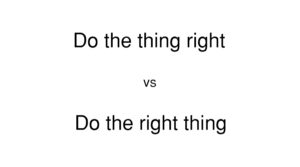
Efficiency is doing a task with the least possible time, money, or energy.
Effectiveness is doing the right task in the first place.

Why Effectiveness Comes First

You can be extremely efficient and still fail if you’re working on the wrong things.

When someone optimizes the wrong task, the resources they “save” don’t matter. They’re still being spent on something that doesn’t move the goal forward. This is why effectiveness precedes efficiency.
Once you know you’re doing the right work, efficiency becomes meaningful.
And when you combine both, clear priorities and smart execution, you get real performance.

Common Failures When Efficiency Comes First

1. Teams that automate the wrong process

Many teams rush to automate tasks to “save time”, but if the task itself shouldn’t exist, the automation only locks them deeper into an unnecessary workflow. They become efficient at producing something the organization doesn’t need.

2. Managers who measure activity instead of progress

Some managers push for more reports, more meetings, and more visible “busyness.” They create teams that look efficient because they move fast and deliver many outputs, but outputs are not outcomes. A team that delivers irrelevant work on time is still failing.

3. Companies that cut costs instead of solving problems

Cost-cutting feels efficient, but it often ignores the real issue.
Companies freeze hiring, reduce training, or shrink support teams, thinking they are optimizing, when in reality, they weaken their ability to execute the work that actually matters.

4. Students who optimize study techniques without choosing the right goals

Many students focus on studying “faster”, watching summaries, or optimizing note-taking systems, but once again, if they’re learning the wrong material or avoiding the core concepts, it doesn’t matter how efficient their method is.

The Relationship Between the Two

It doesn’t matter if you’re extremely efficient, fast, don’t spend a lot of resources, it you’re doing the wrong thing. And if you’re doing the wrong thing, then you’re not really efficient in the big picture. By definition, efficiency requires minimizing the resources spent to achieve a valuable objective. If you’re doing the wrong thing, you’re wasting resources. In that way efficiency follows effectiveness and vice versa.


Still effectiveness must come first, first you need to do the right thing, and then improve the way you do it.

Effectiveness guides direction, efficiency improves the journey.

My experience at WOIC 2025

I attended the World Open Innovation Conference 2025. It was my first time attending any academic-business conference, let alone one centered around open innovation, a field I’m still very new to.

What surprised me most wasn’t the presentations or the structure of the conference (although those were impressive on their own). It was the people. I met researchers, managers, innovators, professors, entrepreneurs, people with decades of experience and still, everyone talked to me. Everyone made space for me. It’s rare to be in a room filled with experts and not feel small.

The highlight of this was meeting Henry Chesbrough, the father of open innovation and the central figure of the entire conference. You’d expect someone in his position to be distant or rushed, but he was the exact opposite. He asked me what I thought, how I felt, whether I understood everything, and if I was enjoying it. He treated my perspective as something that mattered, which, when you’re new, means everything.

I absolutely loved was seeing open innovation in action across such an absurdly wide range of topics. South Korea using open innovation as a tool of diplomacy. Companies using it to reshape their digital strategies. Even researchers applying it to Dungeons & Dragons. It made me realize how flexible and powerful the concept really is, how it’s more than a management idea and closer to a mindset, a way of seeing collaboration everywhere.

Overall, WOIC 2025 was an incredibly positive experience for me. It made the future feel a bit bigger, a bit more open, and a lot more exciting. And if this is what the world of innovation looks like, curious, collaborative, generous, I’m glad I stepped into it.

You need to change

Change is normal. Change is needed. If you want to be someone, you need to change into that someone.

But you can’t grow into a new version of your life while remaining the old version of yourself. If you want different results, you have to become someone capable of creating them.

Change isn’t just for individuals. Everything needs to evolve: universities, companies, teams, systems. Inertia is comfortable, but it’s also deadly. Organizations collapse not because they’re attacked, but because they protect inefficient processes with the classic excuse:  “That’s how we’ve always done it.” Entire institutions defend outdated models long after they’ve stopped working, hoping tradition will compensate for stagnation.

Change is scary. It’s a fear of stepping into a future you can’t fully predict. But the alternative is worse: staying in one place while the world moves on without you. Growth requires discomfort. Innovation requires risk. Progress requires letting go of the familiar.

You need to constantly examine who you are, how you think, and how you work. Because the only thing more frightening than change is waking up one day and realizing that nothing around you changed, because you never did.